
By Natalia Kidd
Buenos Aires, Sep 8 (EFE).- The unexpected scale of President Javier Milei’s party’s electoral defeat sent shockwaves through the Argentine markets on Monday, with government bonds and stocks plummeting and the price of the US dollar skyrocketing.
Investors had expected Milei’s far-right party to come second, behind the Peronist opposition, in the legislative elections in Buenos Aires province, the most populous in Argentina.
By the close of trading on Friday, Argentine bond and stock prices had already reflected the possibility of a victory for the opposition over the ruling party by between three and six percentage points.
However, they did not foresee Milei’s defeat by a margin of 13.57 points, sparking a sell-off of Argentine assets on Wall Street and at the Buenos Aires Stock Exchange.
This outcome sets a negative precedent for the ruling party ahead of Argentina’s national legislative elections on Oct. 26, as well as casting doubt on the government’s ability to advance structural reforms in Parliament.
“Peronism in Buenos Aires won a resounding victory. The victory was expected, but the surprise was the difference of more than 13 points,” said Delphos Investment in a report, predicting that “bonds and stocks will face weeks of weakness until there is greater clarity about the economic and financial situation.”
The S&P Merval index plummeted by 13.25%. The hardest hit were banks and energy companies, with declines of up to 21%.
Meanwhile, Argentine government bonds in dollars fell between 5.6% and 10.4%, and the country risk index climbed to 1,100 basis points, its highest level since October 2024.
Pressure on the exchange rate
The electoral earthquake also shook the foreign exchange market.
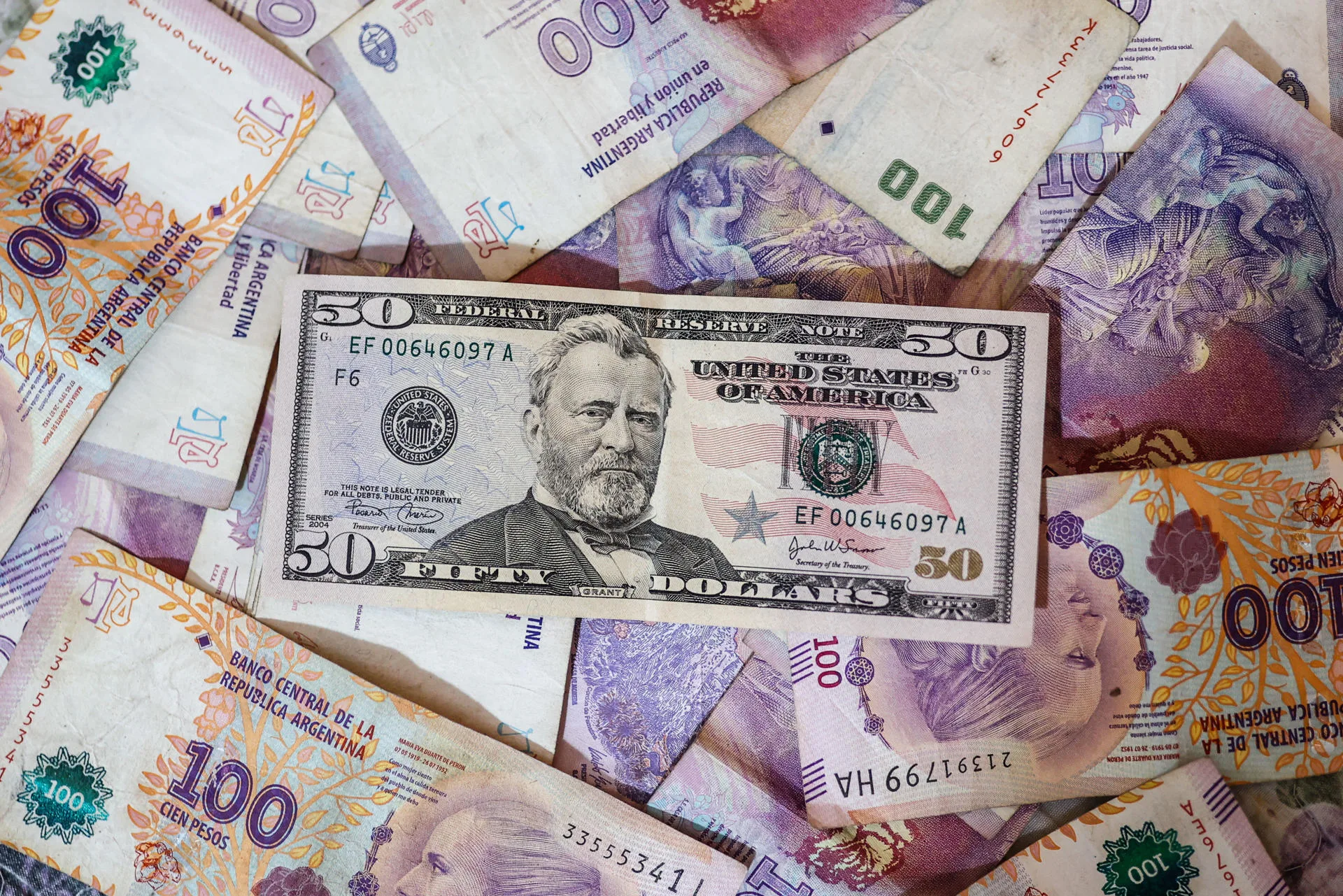
At the state-owned Banco Nación, the price of the US dollar rose by 45 pesos, closing at 1,425 pesos per unit after hitting a record high of 1,460 during the day.
The US currency also climbed in the informal and wholesale markets.
While Monday’s performance was undoubtedly influenced by the election results, exchange rate tensions have been ongoing in Argentina since July due to growing investor scepticism over the sustainability of Milei’s economic plan.
While the government’s severe fiscal adjustments and tight monetary management have slowed inflation, this has come at the cost of a slowdown in economic activity and unresolved issues regarding the accumulation of monetary reserves.
Following Monday’s surge, the US dollar has accumulated a 29.8% gain since April, when Milei’s administration secured a landmark deal with the IMF that eased foreign currency access restrictions and introduced a new exchange rate regime.
Under this regime, the exchange rate floats without Central Bank intervention, provided the price remains in the 951 and 1,471 pesos per dollar range.
However, amid mounting pressure, Argentina’s Treasury announced a week ago that it would intervene in the exchange market, selling around 500 million dollars in an attempt to stem the rise.
“The main risk for the government is macroeconomics. A rise in the dollar to the ceiling of the band could interrupt the disinflation process, deteriorate the mood of the population, and encourage people to vote against the government,” warned Delphos, who argued that the government “needs a political shift”.
However, on Sunday, both Milei and Argentine Economy Minister Luis Caputo stated that there would be no changes in economic policy.
“The question is whether the government will be able to readjust the situation politically and contain macroeconomic pressures, and whether it will be able to reverse its current image of defeat ahead of the national elections in October. The coming weeks will be pivotal, and investor caution is advised,” said Juan Manuel Franco, chief economist at Grupo SBS, in a report. EFE
nk/mcd