
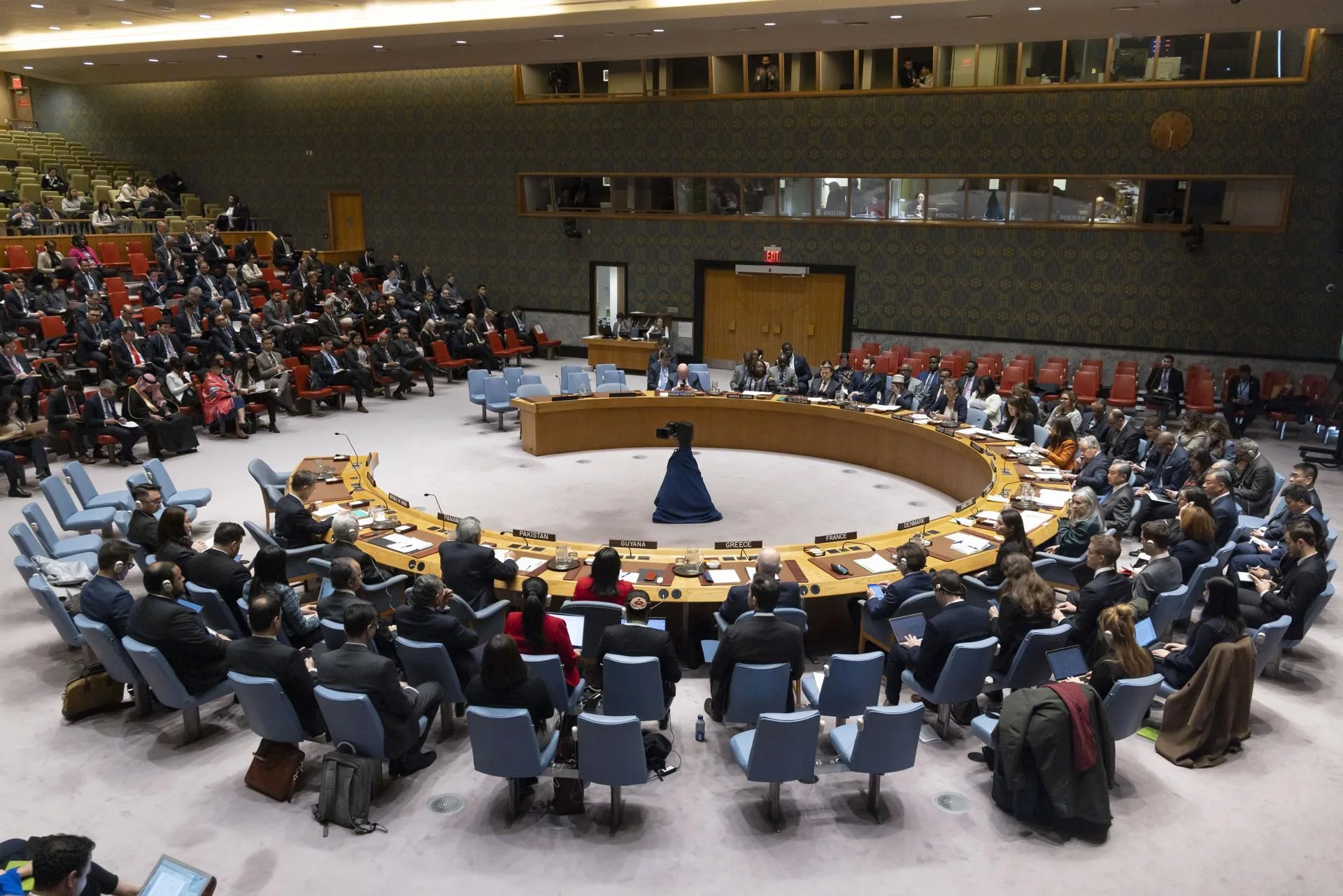
United Nations (EFE).- The United Nations Security Council on Tuesday approved the transition of the Multinational Security Support Mission in Haiti (MSS), led until now by Kenya, into a new Gang Suppression Force (GSF), under a resolution spearheaded by the United States and Panama.
The measure, which takes immediate effect, passed with 12 votes in favor and three abstentions, from China, Russia, and Pakistan, with none against.
The GSF will deploy up to 5,500 police or military personnel, supported by 50 civilian staff, for an initial mandate of 12 months, according to the resolution obtained by EFE.
The MSS, whose mandate was set to expire on Thursday, had aimed to reach 2,500 members but stalled at 970, most of them Kenyan officers, with 700 troops on the ground.
The new mission is expected to retain Kenyan police support, along with reinforcements from Central American and Caribbean nations.
Funding, however, remains uncertain. The resolution specifies that “personnel costs will be borne by voluntary contributions” from participating states.
While the MSS had an estimated 600 million dollars operating budget for its first year, only 115 million dollars was raised.
Contradictory framework
The resolution’s wording raises questions. While it states the GSF will operate under the Haitian National Police (PNH), it also allows the force to act “independently” in targeting gang members.
Human rights groups are alarmed by language noting operations will comply with “international law and human rights, as applicable,” fearing room for abuses in a country already battered by humanitarian crises.
The MSS, which operated jointly with the PNH, was tasked with avoiding the use of lethal force against civilians except in cases of imminent threat. Yet reports of extrajudicial killings by authorities have already surfaced.
Militarization and child combatants
A key change in the new mandate is the inclusion of military units, a move that concerns NGOs, given their limited training in urban crime and community-level interventions.
Gangs control about 90% of the capital of the country, Port-au-Prince, embedding themselves in neighborhoods through local leaders.
The resolution also acknowledges the need to strengthen logistics and equipment to confront Haiti’s gangs, estimated at 5,500 members, with up to 50% of them minors.
“When appropriate and feasible, children detained during operations will be referred to child protection officers,” the text states, offering little detail on disarmament and reintegration programs.
Securing critical infrastructure
The resolution emphasizes the protection of “critical infrastructure and transit routes in coordination with the PNH,” as gangs currently hold control of the capital’s airport and ports, benefiting even from incoming humanitarian aid.
The MSS had planned to establish 12 operational bases across key sites, but managed to open only three before gangs expanded under the Viv Ansanm coalition.
The GSF differs from previous UN peacekeeping operations in Haiti, which ended in 2017. The new force has no formal UN command structure, insulating the organization from potential failure.
Still, the mission will coordinate with a newly established UN Support Office in Haiti (UNSOH) and provide quarterly reports to the Security Council and donors on its performance.
Haiti has had a dozen UN operations aimed at bringing peace and stability to the country since the first in 1993, the International Civilian Mission (MICIVIH), through the UN Stabilization Mission in Haiti (MINUSTAH), to the most recent ones with a hybrid format and without direct involvement from the United Nations. EFE
gac-seo/dgp