
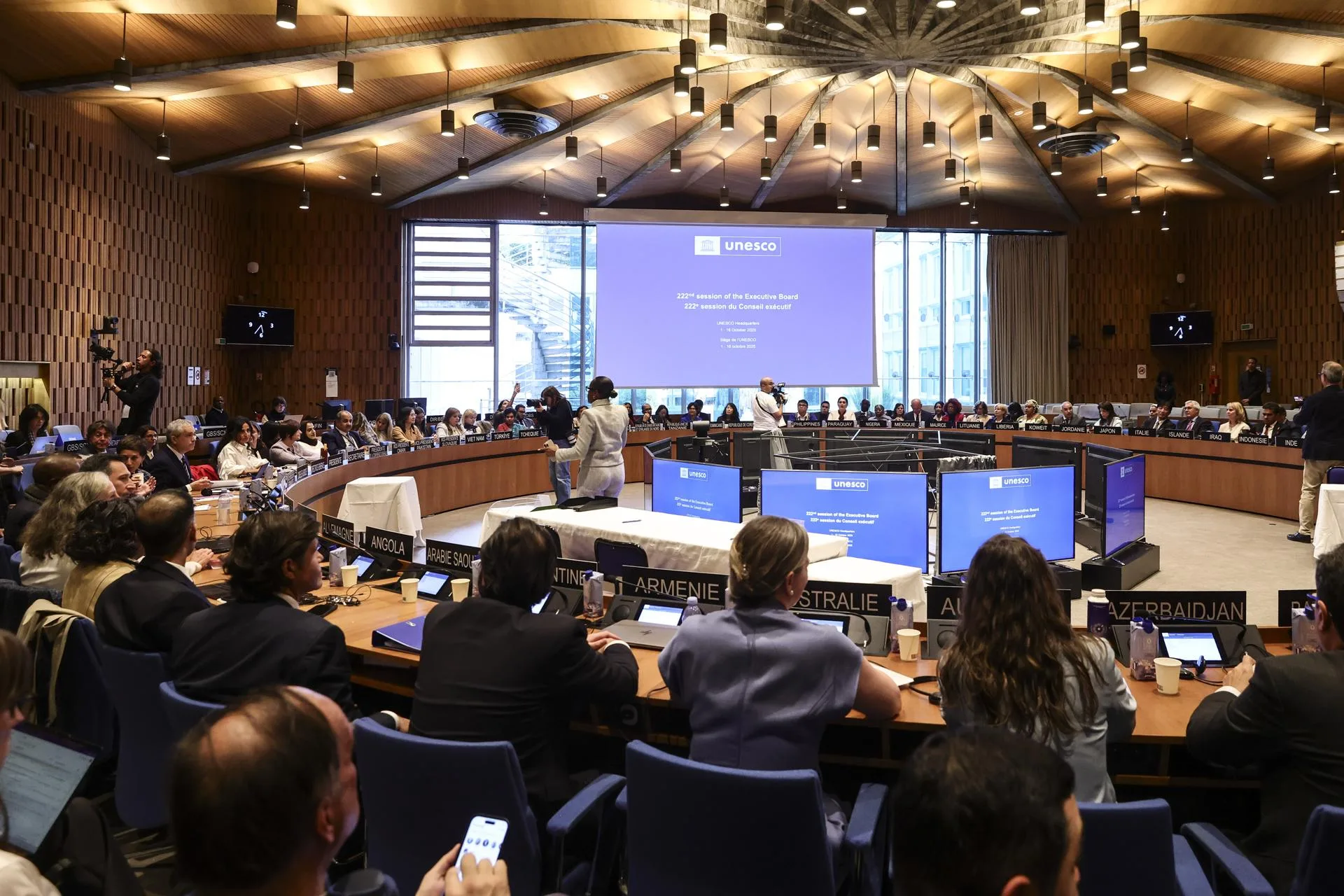
Paris (EFE).- The renowned Egyptologist and former Egyptian Minister of Tourism and Antiquities was one step closer to being elected Director-General of UNESCO on Monday, after receiving the Executive Board’s nomination in Paris.
In a secret ballot, the members of this organization, which is the main decision-making body for UNESCO, overwhelmingly voted for Al-Anani, the favorite, over his only rival, the Congolese candidate, Firmin Edouard Matoko.
The Executive Board’s decision, made up of 58 delegates elected by all member states every four years, will be proposed to the General Conference for a final vote on Nov. 6 in Samarkand, Uzbekistan, where all countries will be represented.
Al-Anani received 55 votes, Matoko received two, and one Council member was absent.
Al-Anani is thus on track to lead UNESCO; the General Conference has never voted against the Executive Board’s proposal for Director-General.
After the results were announced, Al-Anani thanked those who voted for him, promising that he would never take their trust for granted. He assured those who did not vote for him that he would work with all countries without a “geographical or cultural agenda.”
Al-Anani was the only external candidate among the three who presented themselves in March. The others were Gabriela Ramos Patiño, UNESCO’s Assistant Director-General for Social and Human Sciences, who withdrew from the campaign this summer, and Matoko, the 69-year-old Assistant Director-General in charge of UNESCO’s Priority Africa Sector and External Relations.
Al-Anani’s aspirations to lead UNESCO began in 2022 when Egypt’s Minister of Foreign Affairs asked him to accept his country’s nomination.
However, his interest in the organization began much earlier, in the ’90s, when he was studying Egyptology to become a tour guide. At that time, he recognized UNESCO’s unifying role in his country’s heritage conservation projects.
Born in Giza in 1971, Al-Anani’s candidacy was endorsed by the African Union, the League of Arab States, and countries such as Spain, Brazil, Austria, and France, which publicly expressed their support.
“I am prudent. I am a researcher,” he said in response to those who considered him the clear favorite to succeed Frenchwoman Audrey Azoulay.
Al-Anani also insisted that he would not come to UNESCO with a “cultural agenda” or as a spokesman for African or Arab interests but rather to earn the trust of all member countries.
He will also seek to convince those outside the organization, such as Israel, the United States, and Nicaragua, with a depoliticized vision.
With the slogan “UNESCO for the people,” Al-Anani campaigned intensely to become the favorite. He visited 65 countries, including all those on the Executive Board, and advocated for an organization that is more focused on concrete actions.
As he mentioned in meetings with the press before Monday’s vote, this will include a communication strategy that aligns more closely with UNESCO’s real mandate, especially regarding issues such as education.
In light of reduced available funds due to the US withdrawal decided by the Donald Trump administration, which will take effect in 2026, he will also seek synergies within the agency and the United Nations with organizations such as UNICEF.
Although the US contribution accounts for only 8% of UNESCO’s total budget, it accounts for 22% of its regular budget, which is fed from mandatory member quotas and voluntary contributions from countries, social entities, and donors.
To compensate for the US absence, increasing voluntary contributions and seeking more support in the private sector will be priorities, as the private sector currently accounts for only 8% of the budget; however, Al-Anani sees it as an area with the most growth potential.
He considers that the US’s absence will not result in a “clean sweep,” but rather a review of priorities.
After his probable election on Nov. 6 in Samarkand, Al-Anani plans to spend 100 days familiarizing himself with the organization and discussing with member countries.
After this period, he plans to present a roadmap for his four-year mandate, renewable once. EFE
ngp/dgp/mcd